How to Spot a Fake Laptop Discount Before You Buy
Short answer
A laptop discount is only as real as its reference price: if the 'was' price was never charged, held only briefly before the sale, or sits well above what the laptop usually sold for, the saving is smaller than advertised or does not exist.
Key takeaways
- The FTC's Guides Against Deceptive Pricing (16 CFR 233.1) treat a former price that was not openly offered for a reasonably substantial period as fictitious.
- California's Business and Professions Code section 17501 ties an advertised former price to the prevailing market price within the three months before the ad.
- Three patterns cover most inflated discounts: a pre-sale spike, a permanent sale and a list price nobody charges.
- Your own dated price notes are the best evidence; three or more observations are enough to test a claim.
A strikethrough price is a claim, not a fact. It says "this laptop used to cost more," and sometimes that is true. Sometimes the higher price existed for a week before the sale, or never existed at all. The good news is that you do not need inside knowledge to tell the difference. You need a few dated observations and a clear idea of what a legitimate reference price looks like.
What makes a reference price legitimate?
A former price is legitimate when the seller openly and actively offered it, in good faith, for a reasonably substantial period in the recent, regular course of business.
That standard comes from the FTC's Guides Against Deceptive Pricing, 16 CFR 233.1. The guide calls a former price that was not genuinely used "fictitious," and it adds that a reduction can be so small it is meaningless. The guide's example of that is an item advertised as "Reduced to $9.99" when it used to cost $10.
California is more specific. Its Business and Professions Code section 17501 says a price may not be advertised as a former price unless it was the prevailing market price within the three months before the ad, or the date when it prevailed is stated clearly. California courts have read "prevailing market price" as the market's price, not only the advertiser's own.
Neither rule gives you, the buyer, a single number to check. Our discount checker uses a practical stand-in: did the reference price hold for at least 28 of the last 90 days you observed? That figure is a rule of thumb, not law.
Which patterns give inflated discounts away?
Most inflated discounts follow one of three shapes: a pre-sale spike, a permanent sale or a list price nobody charges.
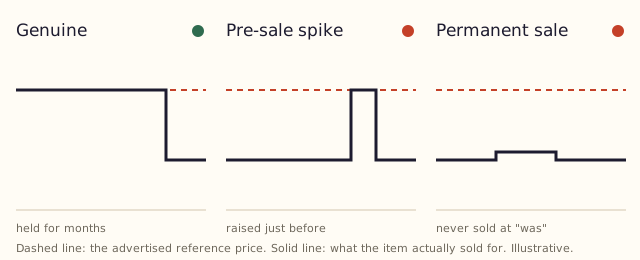
- Pre-sale spike. The price rises shortly before an event, then "drops" back to roughly where it was. The discount is measured from the spike.
- Permanent sale. The laptop is always on sale. The "was" price is a number it never sells at.
- Phantom list price. A manufacturer's suggested price that no store actually charges is shown as the reference, making an ordinary price look like a deal.
How do you test a discount yourself?
Write down prices with dates before you need them, then compare the sale against what you saw.
- Pick the exact model number, including its memory and storage configuration. Names get reused.
- Each time you see a price, note the date, the price and the store.
- When the sale arrives, enter the list price, the "was" price, the sale price and your notes into the discount checker.
- Read the flags. "Reference never seen" and "reference held briefly" are the important ones.
- Look at the median price you recorded. The real saving is the sale price against that, not against the strikethrough.
If you have no history, the checker can still do the arithmetic and tell you it cannot judge the reference. That honest "unknown" is worth more than a confident guess.
What other tricks inflate the deal?
Configuration swaps, bundles and coupons can all make a price look lower than it is.
| Trick | How to check |
|---|---|
| Event-only configuration with less RAM or storage | Compare full spec sheets, not product names |
| Bundle with accessories you do not need | Price the laptop alone elsewhere |
| "Up to X% off" banners | Find the item you want; most items get less |
| Countdown timers | Ask whether the price was lower last month |
| Discount from a refurbished unit's "new" price | Compare with other refurbished listings |
How big should a real discount be?
There is no fixed answer, but Adobe's 2025 holiday data, with computers peaking at 23% off listed price, gives a sense of scale.
A larger number is possible, especially on clearance after a new model launches. It just means the reference price deserves a look. The opposite is true too: a small discount on a laptop that rarely drops can be the best price it reaches all year.
What should you do if a discount looks fake?
Judge the price on its own merits; if it is still the lowest you have seen for a laptop that meets your floor, it may still be worth buying.
A misleading strikethrough does not make the actual price bad. It only means the "savings" line is not information. Check the price against your notes and your spec floor from the budget planner, and buy or walk on that basis.
Questions people ask
Is a 'compare at' price the same as a 'was' price?
No. A 'was' price claims the seller itself charged it. A 'compare at' or 'list' price compares with someone else's price or a suggested retail price, which the FTC guides handle separately and which nobody may actually charge.
Are fake discounts illegal?
Inflated reference prices can violate federal and state advertising law, depending on the facts. For a buying decision, though, the question is simpler: is the price you pay low compared with what the laptop has actually sold for?
What is a good discount on a laptop?
As an order of magnitude, Adobe reported computer discounts peaking at 23% off listed price across the 2025 holiday season. Much larger claims deserve a closer look at the reference price, not automatic suspicion.
Sources
- 16 CFR 233.1, Former price comparisons (Cornell LII)
- 16 CFR Part 233, Guides Against Deceptive Pricing (eCFR)
- California Business and Professions Code section 17501
- Adobe: Cyber Monday 2025 results, discounts by category
Checked November 2026. Programs, dates and terms change; the linked page is the authority.