Is this discount real? Laptop discount checker
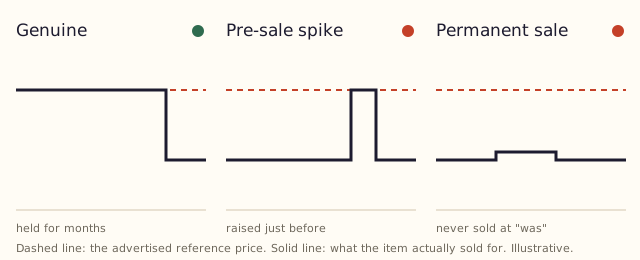
Enter the 'was' price, the sale price and every price you have personally seen with its date. The checker works out how long the reference price actually held, compares the sale price with the typical price you saw, and flags patterns such as a pre-sale spike or a permanent sale.
Privacy: everything is calculated on this page. Nothing you enter is uploaded or stored.
What does the checker test?
Whether the advertised reference price was a price the item actually sold at, for long enough, shortly before the sale.
The FTC's Guides Against Deceptive Pricing say a former price is legitimate when it was openly and actively offered for a reasonably substantial period in the recent, regular course of business. A reference price that was never really charged is described in the guide as fictitious. The checker turns that idea into tests you can run on your own observations.
Which flags can appear?
| Flag | What it means |
|---|---|
| Reference never seen | The highest price you recorded is below the "was" price |
| Reference held briefly | Fewer than 28 of the last 90 observed days at the reference |
| Trivial reduction | Under 5% off, sold as a bargain |
| Was above list | The "was" price exceeds the list price you entered |
| Median below reference | What it usually sold for is well under the "was" price |
| Lowest in your history | Good sign: you have not seen it cheaper |
How do I enter history?
- One line per observation: a date in YYYY-MM-DD format, a space and the price, such as
2026-10-01 899. - Enter each price when you first saw it. The checker assumes a price held until your next observation.
- Add today's sale price as the last line if you want the chart to show it.
What can it not see?
It only knows what you saw. If you checked a price twice in three months, the result is thin, and the checker says so. It cannot see coupons, bundles, other retailers or price changes between your observations. For the patterns it looks for, read how to spot a fake laptop discount.
Questions people ask
Where do I get price history?
From your own observations: screenshots, saved order emails, price alert emails you set up, or notes. The checker never fetches prices. Three or more dated observations give a firmer answer.
Why 28 days out of 90?
It is a rule of thumb, not law. The FTC guide asks whether a former price was offered for a reasonably substantial period in the recent, regular course of business, without fixing a number of days. California's statute looks at the prevailing market price within the three months before the ad. Holding about a month of the last three is a practical test of that idea.
Does a 'Mixed signals' verdict mean the seller broke the law?
No. The checker is a consumer heuristic. It tells you whether the numbers you saw support the discount claim, which is what matters for your decision.
Sources
- 16 CFR 233.1, Former price comparisons (Cornell LII)
- California Business and Professions Code section 17501
Checked November 2026. Programs, dates and terms change; the linked page is the authority.